fulltalk dev
100% local push-to-talk dictation, written in Rust
- Rust
- egui
- ONNX Runtime
- NVIDIA Parakeet
- Wayland
- AT-SPI
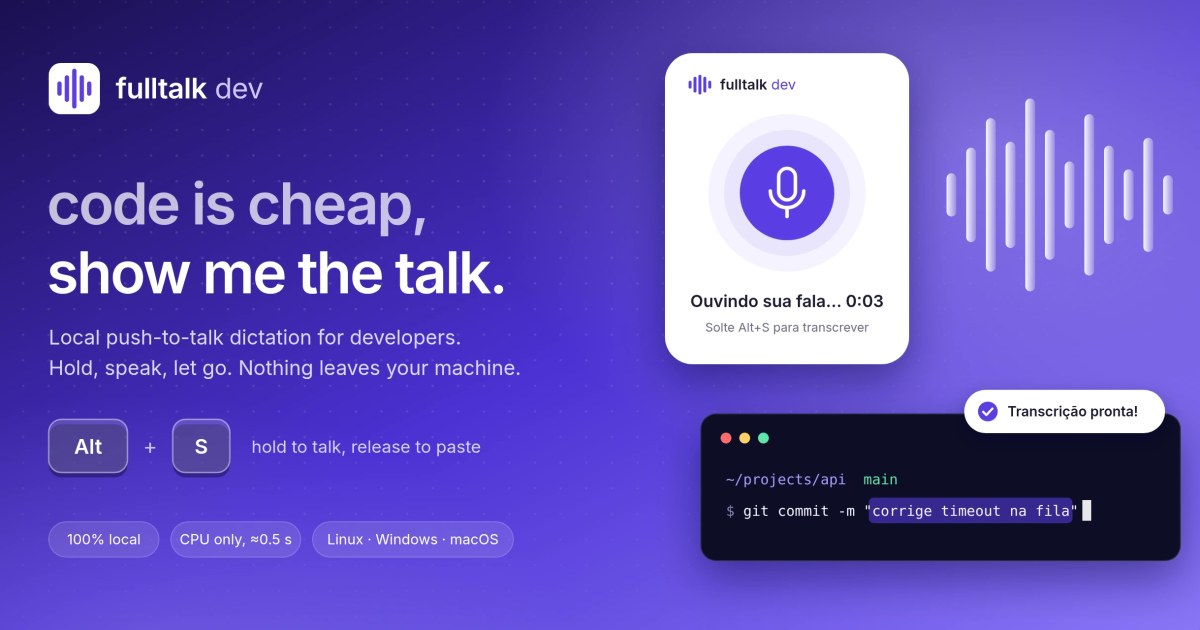
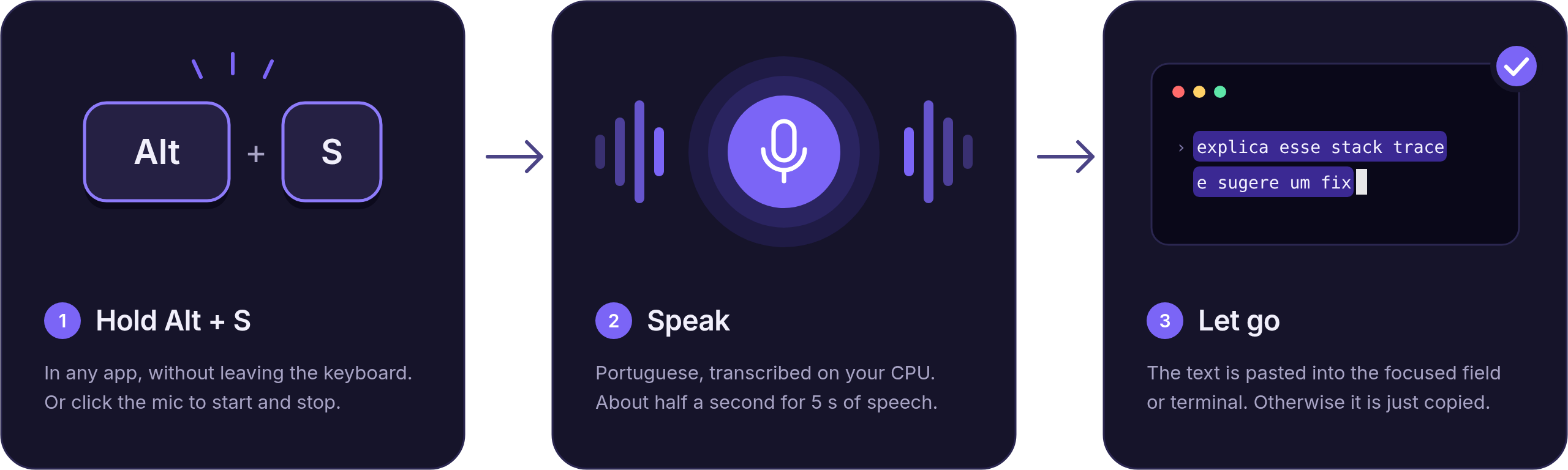
Code is cheap, show me the talk. fulltalk dev is a dictation app for developers: hold Alt+S in any application, speak in Portuguese and let go. The transcription is pasted into whatever field has focus, whether that is an editor, a terminal or a chat. Everything runs locally, on the CPU, and nothing leaves your machine.
What it does
- Hold to talk: a configurable system-wide shortcut, or click the microphone to start and stop.
- Pastes where you are: if a text field or terminal has focus, the transcription is pasted there (with
Ctrl+Shift+Vin Linux terminals). Anywhere else, it goes to the clipboard. - Last 5 transcriptions one click away, persisted across restarts.
- Always on top, never in the way: a compact floating window that never steals focus and can be minimized to a dot on the screen.
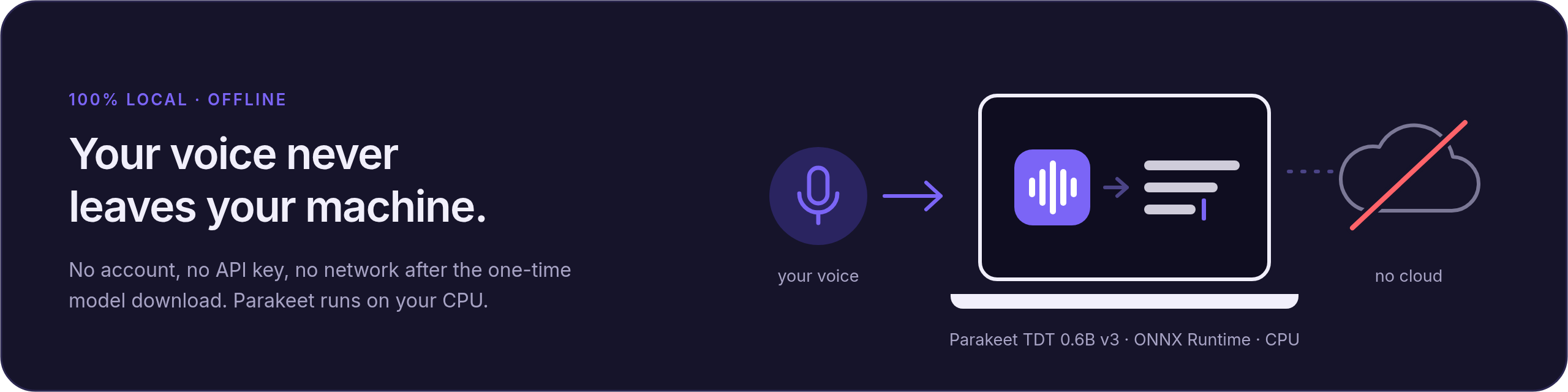
- 100% local and offline after a one-time model download (~670 MB). No GPU.
- Lightweight: a ~40 MB binary, about 0.8 GB of RAM (almost all of it the model) and ~0% CPU at idle.
Performance
Measured on an Intel i7-8550U (a 2017 laptop, 4 cores), release build:
Metric | Value |
|---|---|
Transcription latency, 5 s of speech | ≈ 0.5 s |
Model load at startup | ≈ 3.5 s |
Resident memory at idle | ≈ 800 MB |
CPU at idle | ≈ 0% |
Two optimizations brought memory usage down from 1.5 GB: ONNX Runtime's lean mode, which turns off weight pre-packing (saving ~450 MB for about 12% more latency), and a fixed mmap threshold in glibc, which keeps hundreds of MB of temporaries from model loading from getting stuck in per-thread malloc arenas.
Architecture
The project follows ports and adapters, split into four crates:
fulltalk-core: the session state machine, shortcut detection, the paste-or-copy policy, audio DSP, history and persistence. No I/O and nounsafe, with 97 unit tests plus property tests.fulltalk-asr: the Parakeet engine and a model installer that verifies each file's size and SHA-256 against a pinned revision.fulltalk-platform: per-OS adapters (global shortcut, focus detection, virtual keyboard, clipboard).fulltalk: the egui app (controller, recorder, workers and UI).
Decisions worth highlighting
- The flow is a pure state machine.
Session::handle(Input) -> Vec<Effect>holds all the rules, each one tested without audio, a model or a window. - Pasting is a deliberate decision. The app probes focus first, always fills the clipboard and only sends the paste shortcut when it knows a text field or terminal has focus.
- Wayland treated as a real platform. The shortcut goes through the desktop's global shortcuts portal (with an evdev fallback), the window stays on top via XWayland and pasting goes through a uinput virtual keyboard.
- Focus detection like a screen reader: AT-SPI events on Linux, UI Automation on Windows and AX on macOS, with a time-bounded lookup so a hung app never hangs dictation.
- Nothing blocks the UI thread: download, model loading, inference and delivery all run in workers.
It runs on Linux (X11 and Wayland), Windows and macOS, installed with a single command per platform.
// screenshots