Markmedi
Management SaaS for aesthetic dermatology clinics, built and run end to end
- Laravel
- Vue 3
- Inertia.js
- TypeScript
- Tailwind CSS
- Filament
- MySQL
- Redis
- Horizon
- Reverb
- AWS
- Docker
- Pest
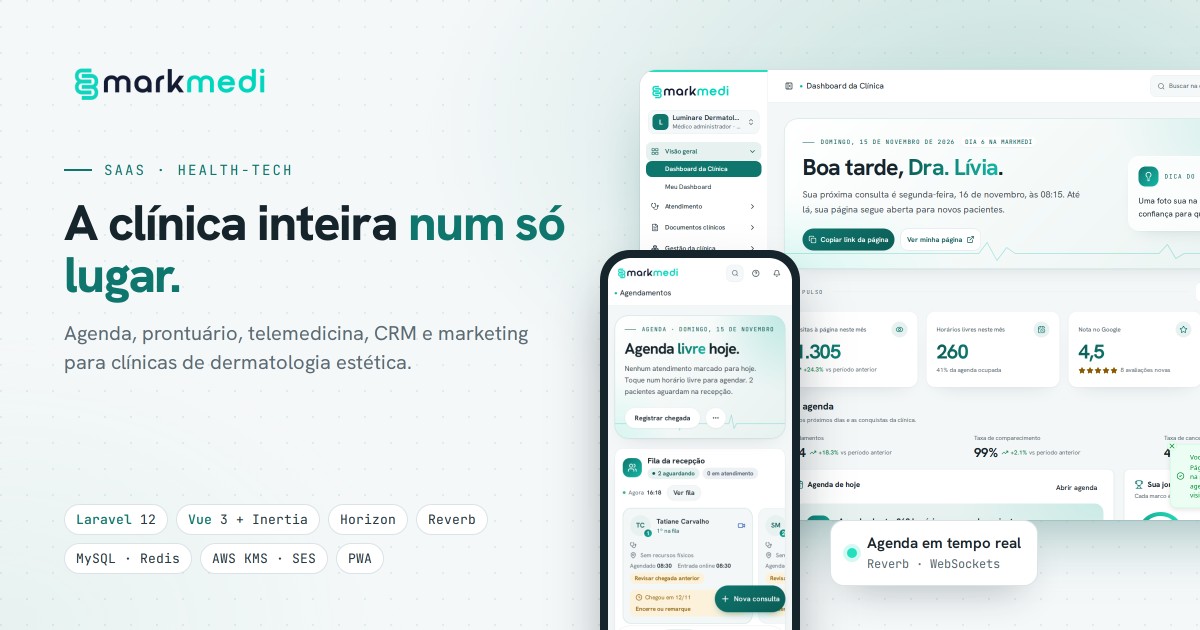
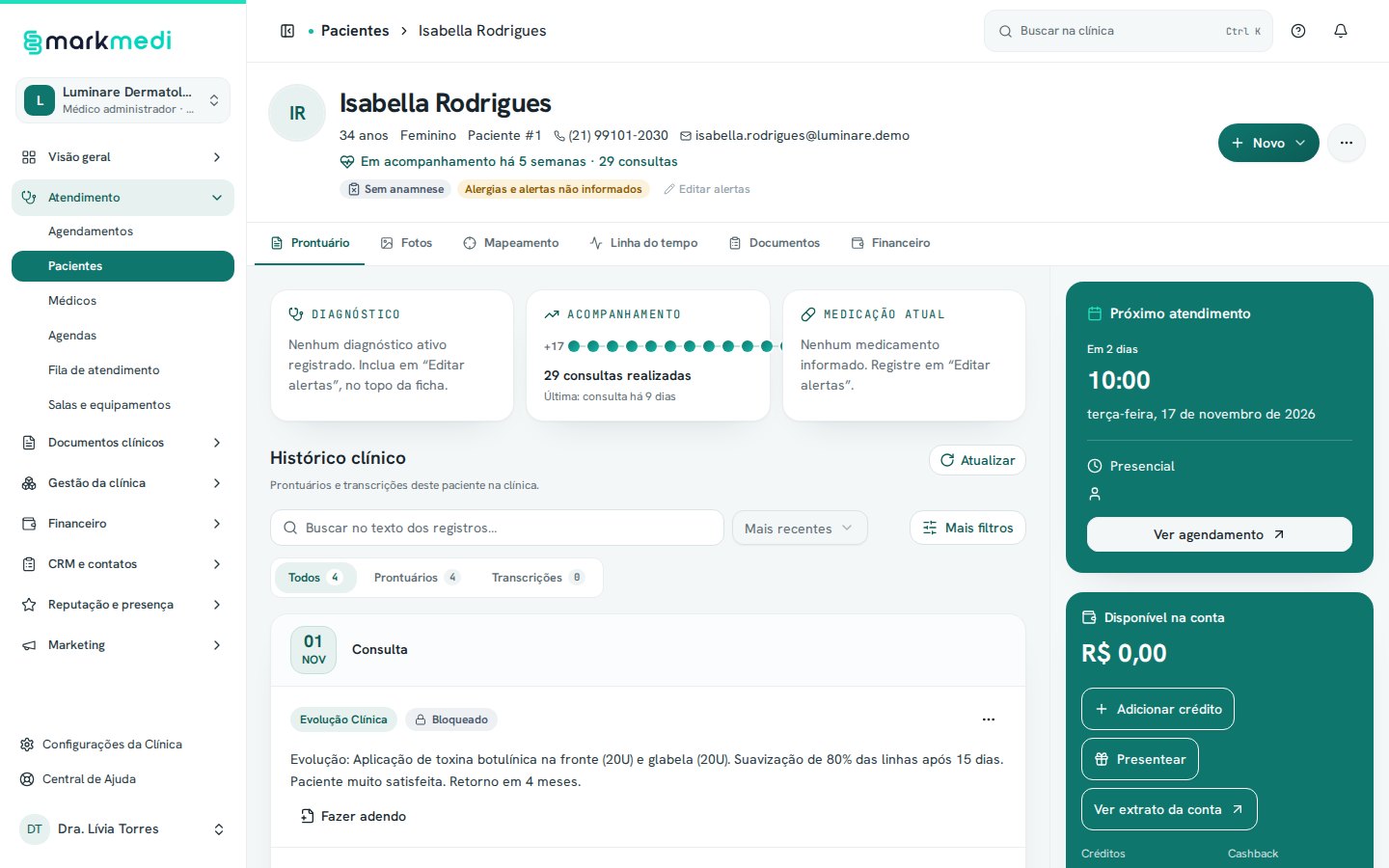
Markmedi is the product I work on today, and the largest one I have ever built. It is a SaaS for aesthetic dermatology clinics that covers a clinic's entire day: the patient books through the public page, gets a confirmation and a reminder on WhatsApp, arrives and joins the front-desk queue, is seen with medical records, progress photos and a digitally signed prescription, pays, rates the appointment and hears from the clinic again when her treatment calls for a follow-up. I founded the company in January 2026 and handle everything myself: requirements, architecture, code, infrastructure and support.
The code is private and will stay that way, but I can explain how it works under the hood. Since there is a lot to cover, I wrote a series of blog posts, one per major decision, and the links are at the end of this page.
What the product does
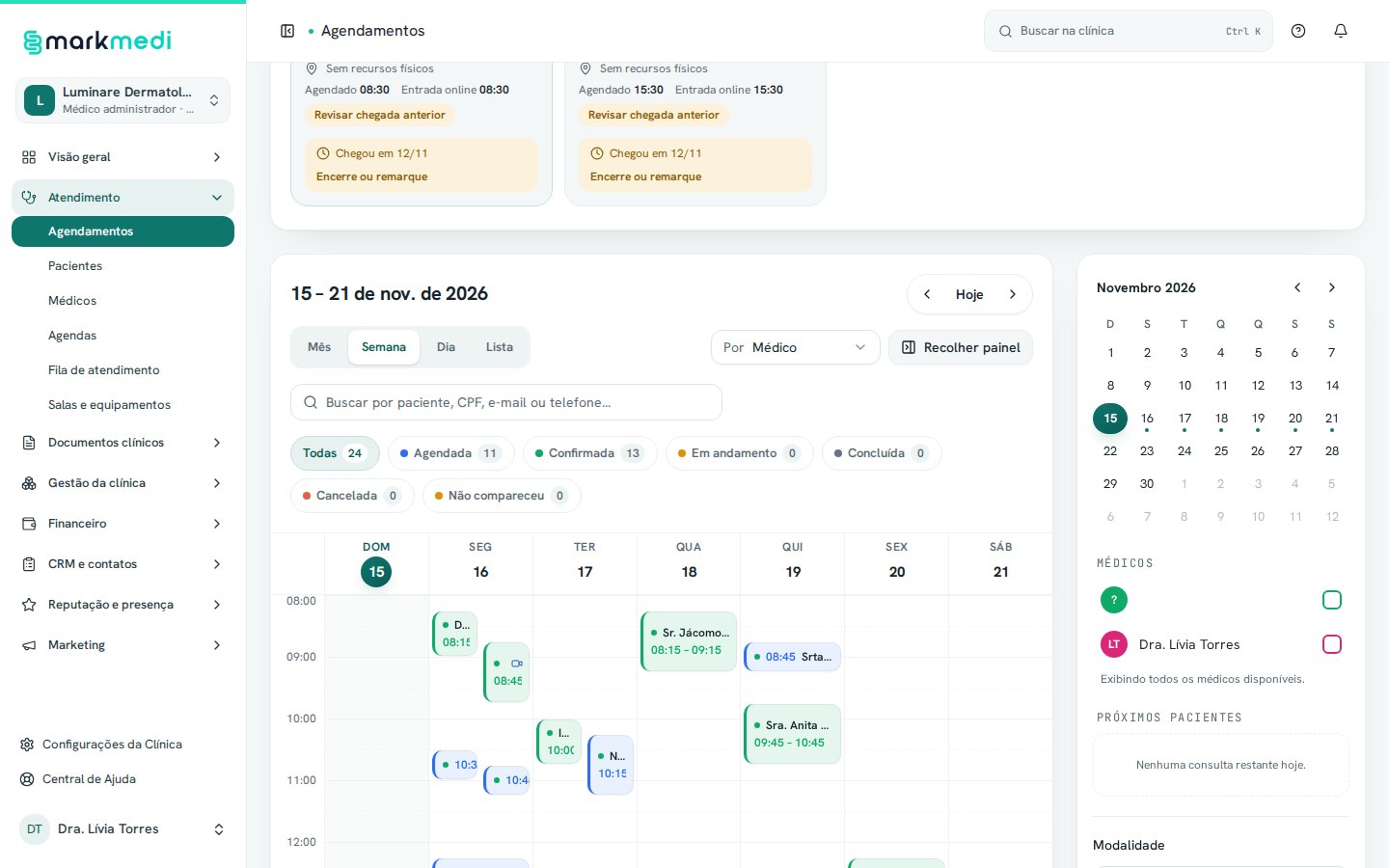
- Patient flow: scheduling by doctor, room and equipment, a public booking page, a waiting list, the front-desk queue and check-in.
- Clinical: versioned medical records, patient history intake, specialty-specific clinical forms, facial mapping, photo series with progress videos, and prescriptions, medical certificates and lab orders with digital signatures.
- Telemedicine: a video consultation room with segment-by-segment transcription and an AI-generated summary.
- Management: finance with cash flow, income statement, professional payouts, health insurance billing (TISS, the Brazilian standard for insurer claims), inventory and treatment plans.
- Growth: a CRM with a pipeline, automations, email campaigns sent from the clinic's own domain, NPS, Google reputation management and search ranking reports.
- Patient: a portal with appointments, documents, prescriptions, forms and a credit wallet.
How it is built
It is a modular monolith in Laravel 12 with Vue 3, Inertia and TypeScript. The backend is split into 33 domain contexts (around 1,500 classes), with business rules in small Actions, enums as state machines and domain events dispatched only after commit. The frontend has just over 200 pages and typed routes generated by Wayfinder. The internal admin panel uses Filament.
Heavy work runs on Redis queues managed by Horizon, with separate supervisors for clinic operations, AI, bulk email and media. Real-time updates, such as the schedule and the front-desk queue, go over WebSockets with Laravel Reverb. Health data is encrypted field by field with a per-clinic key protected in AWS KMS.
The test suite has close to 7,000 cases in Pest, spanning unit, feature and browser tests, and runs on GitHub Actions against PHP 8.4 and 8.5, with dedicated jobs for queues, cache and the MySQL schema. I develop with Claude Code under strict security rules, TDD from the first commit and human review of every change.
Production is lean: a single Hetzner server behind Cloudflare, managed by Coolify, with one Docker image that runs the application, Reverb, Horizon and the scheduler. Encrypted backups go to a separate AWS account with immutable retention, and restores are tested every month.
Behind the scenes, post by post
- Scheduling concurrency: how two patients never end up with the same time slot.
- Queues with Laravel Horizon: workload isolation, idempotency and sending limits.
- Architecture, DDD and event-driven design: the modular monolith from the inside.
- TDD and continuous integration: the tests and the pipeline that runs them.
- Real time with Laravel Reverb: versioned channels and events without personal data.
- Multitenancy and security: isolation between clinics and the security decisions behind it.
- Medical record encryption: envelope encryption with a per-clinic key in AWS KMS.
- First-party tracking in SQL: product metrics without leaking sensitive data.
- Email marketing from the clinic's own domain with Amazon SES.
- Lean, fault-tolerant infrastructure, including the CI/CD flow.
- Markmedi as a PWA: an installable app, self-hosted push and no patient data in the cache.
// screenshots