Gamification in corporate learning: badges, achievements and certificates
How badges, study streaks and certificates break a weeks-long corporate course into micro-tasks, shortening the gap between effort and reward.
 Rafael Faria Ferreira
A company pays for a 20-hour course for its team. The certificate, the promotion or the new skill are weeks away. The inbox is open right now, with ten urgent things in it. When someone has a free half hour on a Tuesday, the course almost always loses, and not for lack of interest: its reward is too far off to compete with what's right in front of them.
That was the problem I had to solve in the B2B ticketing and courses platform I designed and built, focused on corporate training. The answer was gamification, but in a very specific sense. It isn't decoration, or a layer of trophies on top of the course. It is task decomposition.
The core idea: shorten the gap
Behavioral psychology has known this effect for a long time. A reward is worth less the longer it takes to arrive (temporal discounting, or delay of reinforcement). And effort tends to speed up when people sense they are close to the goal, the goal-gradient effect described by Hull and studied in loyalty programs by Kivetz and colleagues. Teresa Amabile reached a similar conclusion about work: feeling progress on something that matters is one of the strongest everyday motivators.
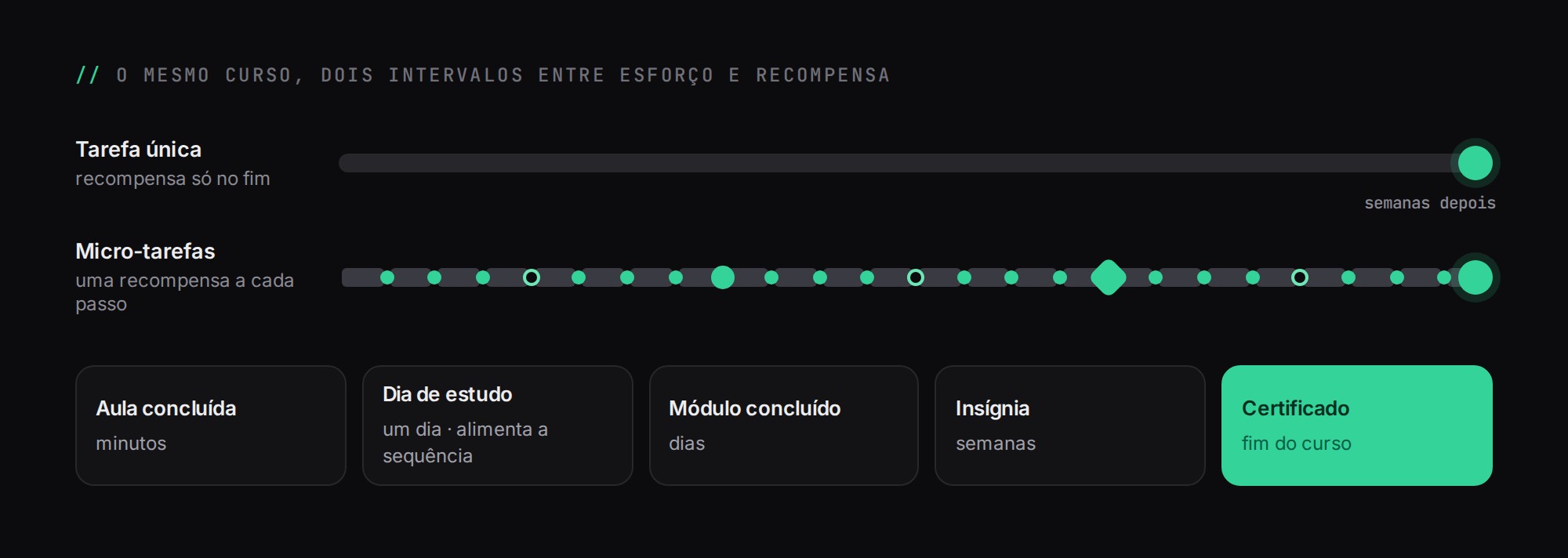
A 20-hour course, seen as a single task, has a distant goal and no sign of progress along the way. Broken into micro-tasks, each with its own reward, the gap between effort and payoff drops from weeks to minutes or days. Learners don't need to finish the course to feel they have moved forward: they need to finish the next lesson.
The reward ladder
On the platform, a course is divided into modules, and each module into lessons. On top of that structure there are five rungs of reward, from the shortest gap to the longest:
| Rung | Typical gap | What has to happen |
|---|---|---|
| Lesson completed | Minutes | Actually watching 90% of the video, reading the text lesson or saving the required activity |
| Study day | One day | Real study on that calendar day, which feeds the streak of consecutive days |
| Module completed | Days | Every lesson in the learner's path and a passed module assessment |
| Badge | Weeks | A criterion configured by the administrator |
| Certificate | End of the course | Course completed |
The lesson is the shortest rung. A video lesson counts as completed when the learner has covered 90% of it. A text lesson is completed when the learner marks it as read, after a minimum time on the page. If the lesson has required activity fields, they need to be saved.
The study day is recorded once per calendar day, in the São Paulo time zone, when there is real study: a stretch of video watched, a text lesson completed or a quiz submitted, even if the learner failed it. Getting an assessment wrong is studying too. Consecutive days form the streak. It counts from today or from yesterday, so people who study at night don't see the number reset in the morning.
The module closes when every lesson in the learner's path is completed and the module assessment has been passed. The default passing score is 70%, and the number of attempts and the interval between them are configurable. Practice quizzes never block progress and are not visible to the manager.
Badges are the middle rung, giving a goal for the weeks between the first module and the certificate. And the certificate is issued automatically when the course ends.
Six badge criteria
The administrator creates badges in the admin panel, and each one uses one of six criteria. The list is closed on purpose. Each criterion has a hand-written evaluator and a progress question the screen knows how to draw, such as "4 of 7 days". A free-form formula field would add flexibility and take both of those away.
- A specific course completed.
- Every course in a set completed, such as a full track.
- N courses completed, for example the first course completed, with N equal to 1.
- N courses in a knowledge area.
- N consecutive study days, for example seven days in a row.
- N hours of lessons completed, for example 100 hours.
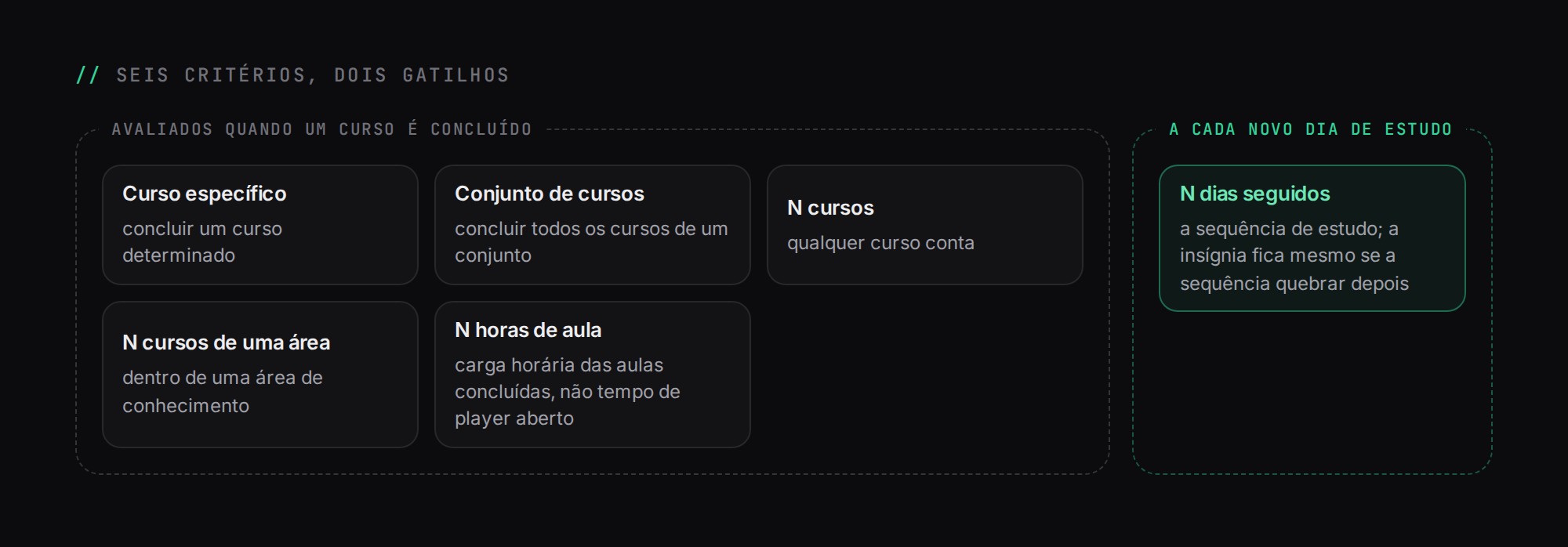
Badges are evaluated at two moments: when a course is completed and when a new study day is recorded. Awarding is idempotent: two simultaneous completions don't produce two badges. Each badge gets a public share page with its own code.
The design rules I followed
Reward learning, not clicks
If a reward can be faked, it stops meaning anything, including for the people who earned it honestly. That's why a good part of the work went into anti-fraud:
- Video progress is stored as a bitmap of 5-second blocks. Skipping to the end doesn't count, and rewatching the same stretch adds nothing.
- A time budget caps credit at what could fit when watching at 2x. Leaving the tab open at maximum speed doesn't speed anything up beyond that.
- Each account watches one lesson at a time.
- The hours badge uses the workload of completed lessons, not wall-clock time with the player open. A lesson left on loop is worth the same as one watched once.
- A study day requires real activity. An "I'm here" signal from the browser doesn't count.
Never take back what was earned
An earned badge stays with the learner, even if the streak breaks later. The streak is the number most likely to turn into anxiety, and I didn't want a week of vacation to erase a milestone. The current number goes back to zero; the achievement doesn't.
Show the next step
The achievements screen shows the entire badge catalog, not just the ones earned. Each one appears as earned, in progress (with progress against its criterion) or locked, with a hint of what's missing. A screen of trophies only tells the past. A locked badge saying "2 courses to go" is what makes someone open the next one.
No leaderboard
The platform has no points, levels or leaderboard. That was a decision, not a lack of time. In a corporate setting, a leaderboard among colleagues exposes people in front of their team and manager, rewards volume instead of learning and demotivates precisely the bottom half, who need the course the most. The same logic shows up in the manager's reports, which hide breakdowns with fewer than 5 people and never show raw diagnostic scores. It wouldn't make sense to protect people in the report and expose them on a scoreboard.
Count outside the platform
An achievement that only exists inside the system has limited value. Certificates are issued one per enrollment, with a verification code, a public validation page, a share page and a link to add it to a LinkedIn profile. Badges also have a public page.
The limits
Gamification has well-known risks, and I'd rather name them.
The first is the overjustification effect. Deci and Ryan's self-determination theory shows that external rewards can weaken internal motivation when they become the goal in themselves. If someone studies for the badge rather than for what they learn, the badge did harm. That's why the rewards here confirm progress that actually happened, instead of creating a parallel task.
The second is the streak. It works partly through loss aversion, and that is exactly what makes it dangerous: losing 20 consecutive days hurts more than gaining the 21st feels good. Keeping the badge after the streak breaks is how I found to reduce that cost without removing streaks from the product.
The third is inflation. A badge everyone earns means nothing. Choosing the criteria and thresholds is up to the administrator, and that choice matters as much as the code.
Beyond courses
The same decomposition works for other corporate processes with a distant reward. A 90-day onboarding can become a sequence of weekly milestones. An annual compliance training can be broken into short blocks with a confirmation after each one. A sales routine can have behavior goals (calls made, proposals reviewed) and not just outcome goals at the end of the quarter. The rules are the same: reward real behavior, show the next step and don't turn colleagues into opponents.
What I would measure next
The system already records what is needed to answer the questions that interest me most. The first is the return rate after a broken streak: do people who lose their streak come back to studying, and within how many days, or do they drop out? The second is completion rate by badge progress: do people who are one course away from a badge finish that course more often than those who aren't? These are next steps, not results.
The path that defines which lessons each person needs to take is the subject of personalized learning paths and andragogy. And the role of the certificate as an acquisition channel is covered in shareable certificates as a growth channel.