Personalized learning paths: the system suggests, the learner decides what to study
How I designed a diagnostic-driven learning path for corporate training, and why leaving the final call to the learner is consistent with andragogy.
 Rafael Faria Ferreira
A salesperson with ten years at the company starts the negotiation course the company bought for the whole team. The first lesson explains what an objection is. The second, how to listen to the customer. By the third he has already opened another tab. Nobody had to tell him the course wasn't for him: his time did.
That is the problem the personalized learning path in the B2B ticketing and courses platform tries to solve. Adults arrive with uneven prior knowledge and very little time. A corporate cohort mixes people who started yesterday with people who could teach the course. Forcing everyone down the same path is the fastest way to lose precisely the most experienced people.
The design decision that guided everything fits in one sentence: the system suggests, the learner decides.
Why this has to do with andragogy
Malcolm Knowles described andragogy through a few assumptions about how adults learn. They are well known, but worth repeating, because each one became a rule in the system:
- Need to know: adults want to understand why they need to learn something before investing time in it.
- Self-concept: adults see themselves as responsible for their own decisions and resist being treated as passive students.
- Prior experience: everyone's background is different, and it is both a resource and a starting point.
- Readiness: they learn best what they need for a real situation they are living through.
- Problem orientation: they prefer applied content over content organized by subject.
- Internal motivation: the strongest motivators are internal, such as competence and satisfaction, more than external pressure.
Deci and Ryan's self-determination theory points the same way. High-quality motivation depends on three needs: autonomy (feeling that the choice is mine), competence (feeling that I'm making progress) and relatedness. A course that ignores what the learner already knows fails the first two at once: it takes away the choice and makes progress feel slow.
How the learning path works
The path is not a playlist the learner puts together. It comes out of a diagnostic.
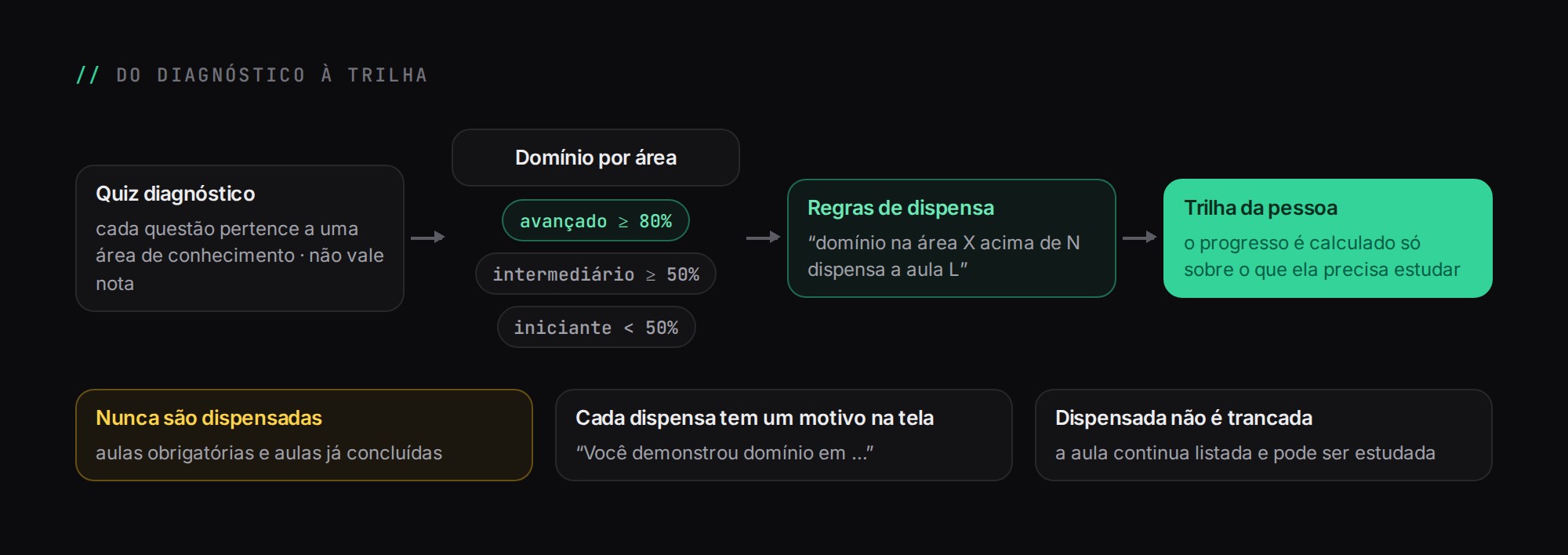
Every question in the question bank belongs to a knowledge area. Whoever manages the course registers waiver rules in the form "mastery in area X at or above N waives lesson L". The learner takes a diagnostic quiz, which can be optional or required by the course. It doesn't block anything and isn't graded. What gets stored is mastery per area, in three bands: beginner (below 50%), intermediate (from 50%) and advanced (from 80%). The cut-offs are configurable. Retaking the diagnostic overwrites the previous one, because what matters is where the person is today.
With the result, the path is recalculated. Lessons the learner has already mastered show up as waived, each with the reason on screen: "You demonstrated mastery in …". The calculation follows four rules:
- A lesson marked as mandatory is never waived.
- A lesson already completed is not waived. It stays completed, so the work the learner has already done doesn't disappear from the screen.
- If two areas waive the same lesson, the one with higher mastery wins, because that is the justification the learner sees.
- Waived lessons are removed from the denominator. They don't hold back completion of the module, the course or the certificate, and the progress percentage is calculated over that person's own path.
The last rule is the one that weighs most on the experience. If waived lessons stayed in the denominator, an experienced learner would see "40% complete" in a course where they had already done everything they needed. Personalization would turn into punishment.
What the learner controls and what is fixed
Responsibility for one's own learning doesn't show up as a slogan; it shows up as concrete controls:
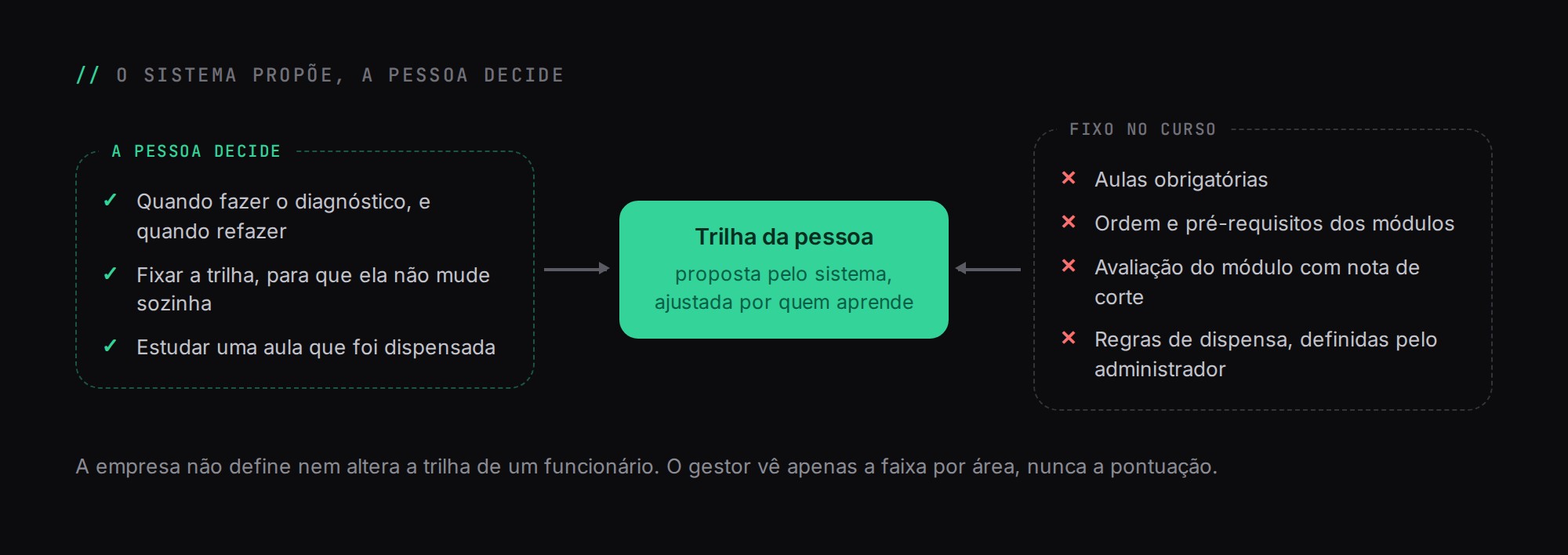
- When to take the diagnostic, and when to retake it.
- Pinning the path. A pinned path is never recalculated automatically. Someone who has organized themselves around a path and watches it change on its own loses trust in it. When they unpin it, the recalculation happens right away, so they aren't left looking at a stale snapshot while believing they allowed changes.
- Studying what was waived. Waived lessons are still listed and clickable. A waiver is a recommendation, not a lock.
When the path changes, the learner is notified and the screen updates in real time. The notification only goes out when the path has actually changed. Announcing every recalculation that changes nothing would teach people to ignore the notice that matters.
What is fixed: the order of modules and their prerequisites, mandatory lessons, and graded quizzes with a passing score. And the company does not define or change an employee's path.
Principle by principle
| Principle | How it shows up in the platform |
|---|---|
| Need to know | Every waiver shows the reason ("You demonstrated mastery in …"). The learner knows why something left their path. |
| Self-concept and autonomy | They decide when to take the diagnostic, whether to pin the path and whether to study a waived lesson. |
| Prior experience | The diagnostic measures what they already know per area, and that mastery removes lessons from the path. |
| Readiness | Time goes to what they haven't mastered yet. Retaking the diagnostic reflects where they are now. |
| Problem orientation | Interactive activities whose answers become a personal workbook at the end of the course, applied to the reality of whoever answered them. |
| Internal motivation | A practice quiz that never blocks and is invisible to the manager. Progress is measured against the learner's own path, so moving forward feels like moving forward. |
The choices that come at a cost
Why mandatory lessons exist
Full autonomy runs into two real constraints. The first is compliance: there is regulatory content the company needs to prove everyone saw, regardless of how much they know. The second is a shared vocabulary: a team that will work together needs to have seen the same definitions. That's why the mandatory rule is absolute and is the first check in the calculation. It also guards against the most likely configuration mistake, which is someone mapping an area to a regulatory lesson.
Why the diagnostic isn't a grade and the manager doesn't see the score
The path is only as good as the diagnostic is honest. If learners think their boss will see the result, they have two bad incentives: guess to look better, or try as hard as if it were an exam. Either way, the measured mastery isn't the real one, and the path gets it wrong.
So the company's manager only sees the band per area, aggregated, never the raw score. Breakdowns with fewer than five people are hidden, because in a group of three the average already identifies someone. Practice quiz attempts are invisible to them. Psychological safety here isn't a nicety; it is what makes the path accurate.
Why "waived" isn't a lock
Hiding waived lessons would look cleaner. But when content disappears, people feel they have lost something. And some people want to review the basics even when they know them, whether to teach a colleague or out of insecurity. Taking that option away contradicts the whole premise. The lesson leaves the denominator, not the screen.
Why I didn't allow reordering everything
The learner doesn't build the path from scratch or reorder the content. Prerequisites between modules exist because whoever designed the course knows what depends on what, and a graded quiz holds the module until the passing score is reached. Unlocking the order would swap one problem (an unnecessary lesson) for another (a lesson without the foundation it needs). The autonomy is in skipping what you already know, not in taking the sequence apart.
What if the diagnostic gets it wrong
It will, sometimes. Someone may guess right and have lessons waived without really knowing the subject, or get answers wrong out of nerves and receive the full path. The mitigations are in the learner's hands: the waived lesson stays accessible, the diagnostic can be retaken, and anyone happy with their current path can pin it. There is also an alert for the administrator when an area used in the diagnostic doesn't waive anything, because that defect is silent: the diagnostic seems to work and changes no one's path.
What was left out
There are no cross-course recommendations, no role-based paths, no company-defined paths and no AI-generated paths. Each of those ideas pulls the decision away from the learner, and I wanted to prove first that the version where they decide works.
What I would measure next
I don't have outcome numbers to show yet, and I won't make them up. What I want to measure:
- Completion rate and time to completion, comparing enrollments with and without the diagnostic in the same course.
- How often waived lessons get opened anyway. A lot of access could mean the waiver rules are too aggressive.
- How many people retake the diagnostic and how many pin their path, as a signal of trust or distrust in the calculation.
The learning path is one part of the platform's motivation design. The other two are covered in gamification in corporate learning and shareable certificates as a growth channel.